
International Open University
> News
News & Events
8th ICIS 2026 : Conference Chair's Opening Remarks
2026-08-29 21:10:41
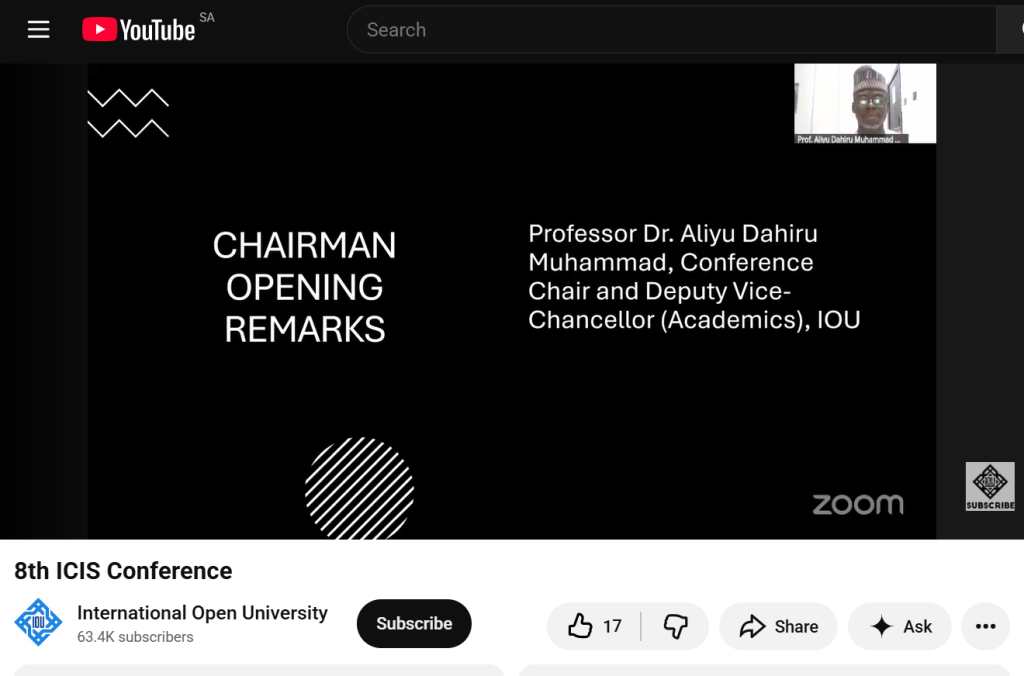
The International Open University Deputy Vice Chancellor (Academics) Prof. Aliyu Dahiru Muhammad and Conference Chair of the 8th ICIS 2026 delivered the following opening remarks at the commencement of the conference :
Speech from the Conference Chair
Bismillahir Rahmanir Rahim.
All praise is due to Allah, the Lord of the worlds. We seek His guidance, blessings, and wisdom as we gather for this important academic occasion. May peace and blessings be upon Prophet Muhammad (peace be upon him), his family, companions, and all those who follow his noble path.
Distinguished keynote speakers, respected scholars, researchers, conference participants, representatives of academic and professional institutions, ladies and gentlemen.
Assalamu Alaikum wa Rahmatullahi wa Barakatuh.
It is my great honor and privilege to welcome you all to the 8th International Conference on Integrated Science 2026, convened under the timely and inspiring theme, “Transforming Knowledge through Innovation, Ethics, and Digital Excellence.”
On behalf of the organizing committee and the International Open University, I extend my sincere appreciation to every participant, presenter, reviewer, sponsor, partner institution, and volunteer whose commitment and hard work have made this conference possible. Your presence today reflects our shared determination to advance knowledge, foster meaningful collaboration, and address the challenges and opportunities of our rapidly evolving world.
This year's conference has witnessed an overwhelming response from scholars and practitioners across the globe. We are delighted to note that over 130 carefully selected papers will be presented during this conference. These papers were drawn from a large pool of submissions and represent diverse disciplines, perspectives, and methodological approaches. The breadth and quality of these contributions demonstrate the growing importance of integrated scientific inquiry and the vibrant global community that continues to support this conference.
The theme of this year's conference could not be more relevant. We are living in an era characterized by unprecedented technological advancement, expanding digital ecosystems, and accelerating innovation. While these developments offer remarkable opportunities for learning, research, and societal progress, they also raise critical questions regarding ethics, responsibility, equity, and human well-being. The challenge before us is not merely to generate knowledge, but to ensure that knowledge serves humanity, upholds moral values, and contributes to sustainable development.
Innovation remains a driving force behind scientific and social transformation. It empowers us to develop solutions to complex problems, improve educational systems, enhance healthcare, strengthen economies, and create new pathways for human flourishing. However, innovation must be guided by sound principles and a clear understanding of its broader consequences.
This is where ethics becomes indispensable. Ethical frameworks provide the moral compass necessary to navigate emerging technologies, artificial intelligence, data-driven decision-making, and digital transformation. As scholars and professionals, we bear a collective responsibility to ensure that progress is accompanied by accountability, justice, integrity, and compassion.
Likewise, digital excellence represents far more than technological competence. It embodies the effective, responsible, and creative use of digital tools to expand access to knowledge, foster collaboration, and bridge geographical and intellectual boundaries. In many ways, digital excellence has transformed the way we teach, learn, conduct research, and engage with global communities. It has opened new frontiers for interdisciplinary scholarship and innovation.
In fact, Today, humanity stands at a defining crossroads. Artificial intelligence, big data, biotechnology, and digital innovations are reshaping economies, educational systems, healthcare, governance, and even human interaction itself. While these technologies offer immense opportunities, they also demand ethical guidance and responsible stewardship.
The Qur'an cautions us:
"Indeed, Allah commands justice, excellence, and giving to relatives and forbids immorality, wrongdoing, and oppression." (Surah An-Nahl 16:90)
The concept of integrated science is especially significant in this context. Many of today's most pressing challenges cannot be adequately addressed through isolated disciplinary approaches. Whether dealing with climate change, public health, economic development, artificial intelligence, educational reform, or social justice, the solutions require collaboration across disciplines and the integration of scientific knowledge with ethical insight and human values. This conference serves as an important platform for such engagement.
As we proceed through the sessions, workshops, and discussions over the course of this conference, I encourage all participants to engage actively, share ideas openly, and build partnerships that extend beyond this gathering. Let us use this opportunity not only to present research findings but also to cultivate new perspectives, inspire innovative thinking, and contribute meaningfully to the advancement of knowledge.
I would also like to express my deep gratitude to our keynote speakers, panelists, reviewers, track chairs, and members of the organizing committee. Their dedication, expertise, and professionalism have ensured the success and academic excellence of this conference.
Ladies and gentlemen, the future belongs to those who can combine knowledge with wisdom, innovation with ethics, and technology with humanity. Let this conference be a testament to our collective commitment to shaping that future for the benefit of our societies and future generations.
I pray that our deliberations will be productive, enlightening, and impactful, and that the outcomes of this conference will contribute significantly to scholarship, policy, and practice across disciplines.
Thank you all for your participation and commitment.
Wassalamu Alaikum wa Rahmatullahi wa Barakatuh.
Prof. Aliyu Dahiru Muhammad
DVC Academics and Chairman of the Conference
 WhatsApp us